Eruvin 63 and 64    Could today’s Gedolim have “Ruach haKodesh” Part 2

In the post on Eruvin 60/61, We discussed various interpretations in the Rishonim of the phrase “דברי נביאות”  attributed to Rabbi Yehoshua ben Levi by Rav Idi.

Whereas most Rishonim do not seem to see this as referring to actual prophecy or “ruach hakodesh,” and some even see it as לגנאי ( a critical statement,) we saw that the Rabbeinu Yitchak, quoted in Tosfos, takes this almost literally and understands it to be referring to actual “ruach hakodesh,” based on a Gemara in Bava Basra.

We mentioned the famous and oft-cited Beraisa that states that “ruach hakodesh” departed from Israel after the death of the last prophets, and suggested that it is due to this Beraisa that most Rishonim did not wish to understand that Rav Idi attributed real “ruach hakodesh” to Rabbi Yehoshua ben Levi.

We also discussed the ruling of the Divrei Chaim that a teacher who claimed that the Ohr haChaim did not have “ruach hakodesh” was a heretic and that removing him from his post was the correct thing to do (though he was not willing to rule regarding the monetary implications of this.)

We pointed out how this ruling seems to be contradicted by the above Beraisa, and that the implication of that Beraisa is that even Hillel did not have “ruach hakodesh,” so the teacher appears  at first glance to have said nothing inappropriate.

Although I left the post without coming to any conclusions and noted that the view of the Tosfos, Ramban and the sugya in Bava Basra would be discussed in a follow-up post when it is next relevant to the daf (my intentions were of course for today’s daf,) I  received an unusual amount of both positive feedback and pushback for it.

I even received a mild and friendly rebuke from my Rebbe, Moreinu haGaon haRav Mendel Blachman שליט”א  for seeming to make light of the words of the Divrei Chaim, whose status as one of the great Torah authorities is debated by none- although I thought it was completely clear that this was not my intention, I wish to clarify again that I was merely attempting to build the sugya in an orderly and exciting  manner and was always fully aware that the Divrei Chaim was fully aware of the Beraisa and had his own explanation thereof.

I was also pointed by more than one to the Gemara on our daf today, which I had already planned on discussing at the appropriate time, which seems to be a clear proof for the approach of Tosfos, at least in theory.

Given the danger of people jumping to premature conclusions and not understanding the purpose of these posts, something I clearly need to be clearer about, I have decided to leave my planned post on Eruvin 62 and 63 for another opportunity and try to address  these issues as soon as possible.

The Gemara brings a Beraisa which narrates  how Rabban Gamliel was riding his donkey and Rabbi Ilai was riding behind him (this is a shortened version-please see the daf for the full version.) They saw a loaf of bread on the road, and Rabban Gamliel picked it up and told Rabbi Ilai to take it. They carried on and saw a non-Jew whom Rabban Gamliel addressed by his name, מבגאי  and told to take the loaf from Rabbi Ilai.

Rabbi Ilai then asked the non-Jew where he was from and what his name was. The non-Jew told him where he was from and that his name was מבגאי. Clearly surprised that Rabban Gamliel had “guessed” his name correctly, he asked the non-Jew whether Rabban Gamliel knew him, and he answered in the negative.

The Beraisa says that we learn from this that Rabban Gamliel כון (directed his thoughts) with “ruach hakodesh.” It also brings 3 other rules that we learn from this story, something we need to come back to a little later.

It seems clear as daylight that the author of this “Beraisa, and the Amoraim who brought it, attributed “ruach hakodesh” to Rabban Gamliel, even though he lived long after the last of the prophets!

There are also various other primary sources that attribute “ruach hakodesh” to other great Tannaim, among them  Rabbi Akiva (see Ran/Nedarim 50b) and Rabbi Shimon bar Yochai (פסיקתא דרב כהנא יא) .

How do we reconcile this with the Beraisa that holds that “ruach hakodesh” departed with the last of the prophets, and that even Hillel never had “ruach hakodesh?”

Several possibilities can be entertained, among them:

i.                    These are contradictory Beraisa’s, reflecting two different views amongst Chazal, and there is no need to reconcile them. Although legal, this approach needs to be reconciled with the Amoraim  who brought each Beraisa, and given that it is not just an aggadic discussion but one that could have major practical ramifications (such as the case in the Divrei Chaim,) one would expect the Gemara to acknowledge such a debate if it indeed existed. It is also an answer of last resort, as the way of Chazal was always to try and avoid machlokes wherever possible and rather reconcile apparently differing views as much as possible.

ii.                  We could be dealing with different types of “ruach hakodesh,” in which case we would need to clearly define each type and prove that such a distinction in fact exists. We shall focus on this approach in more detail below.

iii.                It is possible that נסתלקה רוח הקודש  was not a total end to this experience but rather a general removal whereby it would not be a regular “as needed” experience for all people who merit it, but only an occasional experience by the greatest of people. This could fit well in the context of the Mishnayos and sugya at the end of Sotah, where other things such as chasidim and the wealth of Torah scholars which are said to have ceased after certain key figures died clearly did not disappear completely  (see Beis Shlomo O.C. 112 who makes this point.)

It is thus very plausible that the Beraisa did not mean to say that Hillel and Shmuel haKatan NEVER experienced “ruach hakodesh” but rather that it was not a common experience for them like it was for the Neviim, and/or of a lesser quality.

Evidence for this can be found at the end of this very Beraisa, where we are told that Shmuel haKatan predicted the fates of many of the Tannaim on his death bed, something we also see with Rabbi Eliezer when visited by Rabbi Akiva (Sanhedrin  68a.)- Of course it is also possible that the death-bed of the greatest of people provides a flicker of “ruach hakodesh” not provided during life.

The fact that Rabbi Ilai was so surprised by Rabban Gamliel’s ability to identify the man’s name also attests to how unusual this was, even for Rabban Gamliel, as does that fact that Rabban Gamliel does not seem to have known the halachic status of the loaf via “ruach hakodesh.” (the later point could also indicate that when it comes to halachik rulings, “ruach hakodesh” is not a factor due to the rule of “לא בשמיים היא ” ,or that even unique individuals like Rabban Gamliel did not get assistance via “ruach hakodesh” when it comes to halachik matters. “

Of course, the fact that there were still people great enough during the Tannaic period to merit the occasional “ruach hakodesh,” does not mean that this extended into the period of the Amoraim or later.

Even according to Tosfos who understood that Rabbi Yehoshua ben Levi had “ruach hakodesh,” it should be pointed out that Rabbi Yehoshua ben Levi formed part of the transition period between the Tannaim and Amoraim, and also had his own very unique qualities  ( see Shabbos   156a regarding פנקסו של ריב”ל  or Kesubos 77b regarding חולי רעתן for examples of this.)

Yet the sugya in Bava Basra that Tosfos brings as support, as understood by the Ramban, paves the way for distinguishing between different types of “ruach hakodesh” and attributing one type thereof to a far wider circle of Torah scholars as well as on a far more regular basis.

The context for the discussion there regards the law of dividing up shared property.

Such property may only be divided up at the insistence of one of the partners if it is large enough to be divisible into two viable portions for each partner, otherwise mutual agreement is necessary.

Shmuel’s father and the Tana Sumchus are of the view that when it comes to a vineyard, the minimum size  that is called a “vineyard” is one that can produce 3 kav .  Rabbi Yossi comments that these words of Sumchus  are דברי נביאות , the same expression we saw back on Eruvin 60b.

This leads into the words of רב אבדימי דמן חיפה  who states that from the time of the destruction, prophesy was taken away and given to the חכמים, implying that Rabbi Yossi’s statement is a positive statement attributing prophecy to Sumchus  (though see רי מגש who does not understand it this way at all.)

The flow of the sugya and the various interpretations thereof in the Rishonim are too long to analyze in this post, but the view of the Ramban is so critical to our topic that we have to at least give it a rudimentary treatment.

אלא הכי קאמר אף על פי שנטלה נבואת הנביאים שהוא המראה והחזון, נבואת החכמים שהיא בדרך החכמה לא נטלה, אלא יודעים האמת ברוח הקדש שבקרבם

“rather, this is what he is saying- Even though the prophecy of the prophets, which is the sight and the vision, was taken, the prophecy of the wise-men which comes through the way of wisdom, was not taken- rather they know the truth through the “ruach hakodesh” inside them.”

The Ramban seems to be describing a type of prophecy that comes through the “ruach hakodesh” inside the sages which is a product of their wisdom, and that this type of prophecy was not taken away and remained with the sages.

What the Ramban does not do is explain our Beraisa in Sanhedrin that says that ruach hakodesh departed when the last prophets died.

It is clear historically that the last prophets lived well into the period of the Babylonian exile, after the destruction of the first Temple.

In the absence of the continuation of the sugya in Bava Basra, the story on our daf and other similar cases, it could be possible to suggest that there were two stages:

1.       The era of prophecy proper ended with the destruction but remained with the wiser prophets through “ruach hakodesh” for some time and this is the type of prophecy that the last of the prophets experienced in the exile.

2.       When these last sage-prophets died, this “ruach hakodesh” via wisdom type of prophecy also departed.

Yet from the continuation of the sugya in Bava Basra where various Amoraim bring examples of this wisdom-derived prophecy in every-day life, this does not appear to be the case, and cases like those of Rabban Gamliel on our daf also make this suggestion implausible.

It thus seems most likely that just like there are two types of prophecy, there are also two types of “ruach hakodesh” and that the “ruach hakodesh/prophecy” inspired by wisdom outlived the time of the prophets well into the period of the Tannaim, some of the greatest of whom were endowed with it.

It is also possible that this wisdom related “ruach hakodesh” of the Ramban never completely ceased and that at least some of the greatest sages of each generation too have some degree of it, according to their merit, though whether this “ruach hakodesh” simply assists one’s natural intellect to come to correct halachik conclusions or goes so far as to allow one to discern secrets and predict the future is also not clear- whereas the case of Rabban Gamliel certainly seems to involve the later, the examples brought by later Amoraim in Bava Basra seem more focussed on the former.

What seems clear from the case with Rabban Gamliel, however, is that at least the type of “ruach hakodesh” which gives “supernatural” knowledge of facts or possibly even the future, is NOT  a regular event, and was not even experienced by most Tanaim, let alone later authorities- otherwise it would not have been recorded as a novelty.

This is further substantiated by the case in Eruvin 63a of the student of Eliezer who transgressed the serious prohibition of ruling in halacha in front of his Rabbi.

Rabbi Eliezer told his wife that that student would not live through the year, and it was.

When asked whether he was a prophet, he replied that he was not, but that he simply had a tradition that someone who makes a halachik ruling in front of his Rebbe deserves to die.

We see that Rabbi Eliezer’s wife was very surprised that he seemed able to see the future to the point that she asked him incredulously whether he was a prophet- This in itself shows that it was certainly not the norm for great Tannaim to be able to see the future.

Unless it was said merely out of humility, Rabbi Eliezer’s answer also makes it clear that he did not consider himself to have this ability either, and given the context of the sugya which discusses this prohibition and its punishment, this is likely to be what it he meant (though it is still difficult how he knew that the punishment would occur within the year and that it would definitely take place, given that he could always repent and be exempted from this punishment- perhaps he did experience some form of “ruach hakodesh” and his answer was indeed out of humility? Either way, we certainly see that this was certainly not the norm by the Tannaim.)

Back to the wisdom-derived form of “ruach hakodesh” discussed by the Ramban, The Divrei Chaim in the earlier quoted teshuva makes it clear that it is this type of “ruach hakodesh” that he is referring to, and it appears that he had reason to believe that the teacher had denied that the Ohr haChaim had even this kind of “ruach hakodesh,” something he saw as an extreme sign of disrespect for someone he held up as one of the greatest sages of his time.

Whether this is the final word on the subject, whether the teacher indeed had that kind of “ruach hakodesh” in mind, and whether the view of the Ramban is indeed compatible with the view of many of the other Rishonim is beyond the scope of this  post  – much has been written on the subject and I hope we shall get a chance to revisit this again- the reader is encouraged to pursue this topic further outside the scope of this post, obviously based on authoritative sources only.

These posts are intended to raise issues and stimulate further research and discussion on contemporary topics related to the daf. They are not intended as psak halacha.

Eruvin 60 and 61 Do Gedolim have “Ruach haKodesh”

In a rather unusual responsa, Rav Chaim of Sanz (the Divrei Chaim,) founder of the Sanz dynasty of Chasidim (Y.D. 1/105,) dealt with the issue of a school teacher who had told his students that Rabbi Chaim Attar, author of the famed “Ohr haChaim” super-commentary on the Chumash, did not write his work with “ruach haKodesh” (“holy spirit-“ loosely translated as “divine inspiration” and possibly described as a form or means of prophecy.)

The teacher was fired from his position, and the Divrei Chaim was asked whether this was the correct decision, to which he responded in the affirmative, going so far as to say that the author of any great Torah work who is fit for it, can be said to have ruach-hakodesh.

This position seems rather problematic at first glance, given that the Gemara (Sanhedrin 11a and various other places) brings a Beraisa which states that ” משמתו נביאים האחרונים חגי זכריה ומלאכי – נסתלקה רוח הקודש מישראל, ואף על פי כן היו משתמשין בבת קול (Once the last prophets, Chagai, Zecharia, and Malachi died, “ruach haKodesh” departed from Israel, and nevertheless,they would make use of a “bas kol.”

It continues to tell how a voice from heaven once proclaimed that there was someone worthy of having the שכינה rest on him like Moshe Rabbeinu, but the generation was not worthy, and the sages assumed it was referring to Hillel!

This Beraisa seems to imply a number of things, among them:

  1. Ruach hakodesh is tied to prophecy, and when prophecy ceased, so did it.
  2. Even arguably the greatest sage of the early Tannaic period, Hillel himself, did not have “ruach hakodesh.”

The Divrei Chaim’s claim is also particularly ironic, given that the Ohr haChaim himself (Bereishis 6/3 ( states emphatically that there is not even a ריח (smell) of “Kodesh” left in our time, never mind “ruach hakodesh.” (thanks to http://parsha.blogspot.com/2011/07/or-hachaim-that-we-no-longer-have-ruach.html?m=1 )

Yet at the bottom of Eruvin 60b, Rav Idi quotes an important rule regarding Eruvin in the name of Rabbi Yehoshua ben Levi.

Although there is a rule that an entire city (at least a walled one) is considered like 4 amos, and thus counts very little towards the 2000 amos a person is allowed to walk on shabbos, this rule is not absolute, and only applies in certain circumstances.

For example, if a person’s shabbos base is outside the city, and the city fits in its entirety into the 2000 amos of his techum, it only counts as 4 amos and he earns the rest of the length of the city in the same direction on the opposite side of the city. (כלתה מדתו בסוף העיר)

However, if the 2000 amos of his techum ends somewhere in the middle of the city (כלתה מדתו בתוך העיר) , then the city counts as part of the 2000 amos, and he may not move past the point where it ends, even within the city itself.

After reporting this view in the name of Rabbi Yehoshua ben Levi, Rav Idi comments that “אין אלו אלא דברי נביאות” (lit- these are only matters of prophecy), as on a logical level, there should be no difference in the law between the two cases.- either the city should count as part of the 2000 amos either way, or be considered as 4 amos in both cases!

Rava then takes issue with Rav Idi’s comment by bringing evidence from the next Mishna that this distinction indeed exists, after which Rav Idi holds his ground and explains the Mishna in a way that it does not serve as precedent for our case, in a discussion that carries over onto Eruvin 61a.

There are various ways to interpret the comment of Rav Idi regarding Rabbi Yehoshua ben Levi’s ruling being “דברי נביאות”

  1. This could be understood literally as coming to praise and agree with Rabbi Yehoshua’s ben Levi’s words by saying that they were derived prophetically by him , without any earlier source or logical principle to back them up. This is the approach that Tosfos takes, bringing another sugya (Bava Basra 12a) to back up his view. In Tosfos haRosh, the Rosh seems to take a similar approach.
  2. Rashi, possibly unwilling to entertain the notion that Rabbi Yehoshua ben Levi experienced prophecy or even “ruach hakodesh,” takes a more nuanced view of this approach. He too, understands that Rav Idi views the ruling of Rabbi Yehoshua ben Levi positively and as being, at least to some extent, prophetic, but does not attribute this prophecy to Rabbi Yehoshua ben Levi himself. Instead, he explains that in the absence of any logical or textual evidence for his rule, he must have received it as a tradition from his Rebbe going back to something heard מפי הגבורה (by Moshe from Hashem) at Sinai! This explanation is also brought by the Ritva.
  3. Rabbeinu Chananel, seemingly unwilling to treat this ruling as any form of prophecy, seems to understand that Rav Idi simply meant that it was a גזירה of Rabbi Yehoshua ben Levi himself, without textual support or obvious logical basis. He also seems to understand that Rav Idi meant to weaken Rabbi Yehoshua ben Levi’s statement, not strengthen it.
  4. As mentioned above, it is also possible that Rav Idi is not coming to strengthen the status of Rabbi Yehoshua ben Levi’s ruling, but rather to weaken it, and possibly even rule against it. His labelling of his words as דברי נביאות could be somewhat sarcastic, as if to say that the only way he could have come up with something like that was through prophecy, which he clearly did not have.
  5. Without going so far as in the above point, it could be that Rav Idi is attributing a certain degree of prophecy to Rabbi Yehoshua ben Levi, but views such a source for halacha as inferior to one grounded in textual and/or logical support, and perhaps unauthoritative, given the principle of לא בשמים היא.

The Rif and the Rosh both state that we rule like Rabbi Yehoshua ben Levi because Rava brings a Mishna to support them, even though Rav Idi was able to explain the Mishna differently. Though they point out that Rav Idi’s main intention was not to rule differently, it seems that they acknowledge that he indeed did hold differently, or at least made his comment to weaken the authority of Rabbi Yehoshua ben Levi’s ruling rather than strengthen it. A similar approach can also be seen in the Meiri.

It seems clear from the above that most Rishonim do not take the comment of Rav Idi to mean that Rabbi Yehoshua ben Levi actually had prophecy and/or “ruach hakodesh, even if this is the most simple reading of the text.

It seems compelling that the reason they did not do so might well be because this would contradict the often quoted earlier source that “ruach hakodesh” and “prophecy” are either equivalent or at least go together, and that both ended with חגי זכריה and מלאכי .

The Tosfos, on the other hand, who do understand Rav Idi’s comment literally, need to deal with this issue, and this takes us into a study of the sugya he quotes in Bava Basra, as well as a fascinating Ramban, which I hope to go into in a couple of days when we revisit this discussion, Hashem willing.

These posts are intended to raise issues and stimulate further research and discussion on contemporary topics related to the daf. They are not intended as psak halacha.

Eruvin 59    Authoritative Translation and the “private city”


The wealth of modern-day translations and study-aids has made the study of our sacred texts accessible to so many people who without them, would simply be unable to study them, and for this, their merit is tremendous.
Yet there is also a downside to this, in that people who study Torah from their youth and would normally learn the original Hebrew and Aramaic naturally from the original context of their study, now tend to use these works as crutches rather than learning the necessary linguistic skills themselves from classical sources.
As so much of the original meaning is lost in translation, and one translation might give a completely different view of a word or phrase than another, this often biases the learner in favor of the translators subjective interpretation of the text, rather than training him to study the text objectively on its own merits.
At its extreme, this results in the loss of the  independent analytical skills essential for in-depth Torah study and for reaching legitimate halachik conclusions, effectively starting a chain reaction which has the ability to paralyze the entire traditional system of Torah study and halachik ruling.
Yet how is a generation whose spoken language is neither Aramaic nor biblical or Mishnaic Hebrew expected to even get started without the use of such tools?
It is clear that there is always going to be a tradeoff between exposure to unbiased original texts and the clarity provided by modern “translation-commentaries” and what is right for one, is not necessarily right for the other, but it is clear that the earlier back one can go for translations, the more legitimate one’s starting point will be.
The earliest and most authoritative “dictionary” of Talmudic language is the “Aruch”, written by Rabbeinu Nosson of Rome, an early Rishon who slightly preceded Rashi, and whose translations are used by him and other Rishonim in their commentaries.
As such, this is the first place us “uneducated” moderners should turn when faced with words that we do not understand, something our great teacher haGaon Rav Mendel Blachman שליט”א  has drummed into us (of course an authoritative Hebrew dictionary will be needed once we have the correct hebrew word and using later scholarly dictionaries such as that of Rabbi Marcus Jastrow זצ”ל  are still far preferable than jumping to the translation-commentaries of today, certainly for in-depth study if time does not allow it for the daf yomi!)
It is this approach that I would like to illustrate in today’s post, using the main topic of the daf as a case study.
Today’s daf discussed the fascinating case of an עיר של יחיד ונעשית של רבים – a private city that became public.
We have seen many times that when it comes to defining a domain as either private or public as far as the laws of Shabbos are concerned, there are several factors involved:
1.      Whether it is surrounded by halachically valid מחיצות  (partitions) or not
2.      Whether it is used/frequented by the public or not.
3.      The size or width  of the domain and its similarity to the דגלי מדבר
 
The actual ownership of the domain, although important on a rabbinic level, seems to be less of a factor regarding its biblical status, and when the above factors are combined, we are faced with 3 main categories of domain, at a biblical level:
1.      רשות הרבים – a public domain needs to be unfenced, be used/frequented by the public and have a minimum width of 16 amos.
2.      רשות היחיד- a private domain needs to be enclosed by halachically valid partitions on at least 3 sides (2 according to Rabbi Yehuda) and be a minimum of 4 by 4 tefachim.
3.      A כרמלית  – this is domain which lacks the partitions required to make it a private domain but lacks the public usage/frequency required to make it a public domain. On a biblical level, this is essentially a מקום פטור  (exempt domain)- on a rabbinical level , it is treated with the stringencies of both the above domains, and only very limited types of domains too small or high to fit into the other categories are still regarded as a מקום פטור  (exempt domain.)
In the case of our Mishna, a city starts out as a “private city” ,undergoes a metamorphosis which results in it being a “public city” ,and the Mishna rules that the entire city may be included in an eruv.
In contrast, if a city starts out as a “public city” and becomes a “private city”, certain restrictions of a public city still apply to it and one needs to leave a small part of it outside the eruv.
It is not immediately clear from the Mishna what the properties of the private city and public city mentioned are, and what exactly changed to make the city take on the opposite status.
After all, if a “private city” is a pure רשות היחיד  , why should it need an eruv at all, and if  a public city is a pure רשות הרבים  , then how does an eruv help anymore than it does in a regular רשות הרבים  which according to most opinions cannot be “privatized” by a regular eruv?
It is thus not surprising that the Gemara asks immediately what the phrase עיר של יחיד  is referring to and Rav Yehuda suggests that a prime example of such a construct is the “דאיסקרת דריש גלותא” .
In this case, The editor’s note on the side inform us that the ערוך ‘s version of the text has the word “דסקרתא”, and this is also the version in Rabbeinu Chananel on the daf,an invaluable clue that allows us to look up the word in his ערוך  itself.
Examining the words ourselves, we see that “דסקרתא”  is made up of “דס”  and “קרתא” ( city) , and immediately can guess that this is some sort of city belonging to the exilarch, the powerful political head of the Jewish communities of Babylonia.
The Aruch translates it simply as “עיר של ריש גלותא”- the city of the exilarch
In other words, the city is
i.                    Owned and/or controlled  by one individual (“של”)
ii.                  That one individual is a powerful public figure with government supported authority over property rights  ( -“ריש גלותא” see Sanhedrin 5a re נטילת רשות)
 
     We note that there is no inherent assumption that this city is surrounded by walls or partitions as is the case with a halachik רשות היחיד.
It follows that whatever changed to make it into a “עיר של רבים ”  must involve one or more of the above factors, and while the Gemara proceeds to reject this definition and accept a different one, we have now at least set the stage for beginning to understand what the issues at play are!
 These posts are intended to raise issues and stimulate further research and discussion on contemporary topics related to the daf. They are not intended as psak halacha.

Eruvin 57 and 58 Nature trails on Yom-Tov and measuring the techum with Google Earth

Whereas most of daf 57 focusses on the extended boundaries of cities, in particular another possible leniency that according to some allows an additional 70+ amos to be added to the city- proper’s boundaries, the Mishna at the bottom of 57b takes us into new territory- the correct method for measuring the techum.

In a time where walking between close-by city’s was normal and often required, much effort was made by each community to measure and mark the techum of their city, and 2 people worked together to do this rather complex task.

This requirement, however, is FAR from obsolete and should be done in any community where leaving the halachik boundaries of the city on Shabbos or Yom-Tov is common- this would include walking between two suburbs of a city that are separated by more than 141 amos of open space, a fairly small area which is enough to make them considered two different cities halachically, as well as towns bordering natural areas where people like to enjoy the trails (Ramat Beis Shemesh being a great example, with our lovely nature walks.)

The method set out by Chazal, and hinted at in pessukim, was that a rope measuring 50 amos would be held at either end by each partner at chest level- after shifting forward 50maway from the city, this would be repeated until 40 such measurements had been taken, and the techum boundary would be marked at this point .

This process would be done 8 times, at each end of the 4 sides of the square/rectangle that the city had been fit into, after which the final process of squaring the techum itself could be carried out.

The Mishna tells us that ” אין מודדין אלא בחבל של נ’ אמה לא פחות ולא יותר” – We may only measure with a rope of 50 amos, no more and no less.

The Gemara bases this length on the passuk describing the width of the Mishkan’s courtyard. “ורוחב חמישים בחמישים” – its width was 50 with 50. The seemingly spurious “with 50” teaches us that it should be measured with a rope of 50 amos, and this seems to serve as a precedent that things which require precise measurements should be measured with a rope of 50 amos.

The Gemara understands ( as per Rashi’s explanation) that any more than this would be too hard to pull tight enough, resulting in some sagging and a shorter measurement for the techum.

Similarly, any less would result in too much stretching and hence a larger techum than required.

The Gemara proceeds to discuss what material the rope must be made of and seems to conclude that it needs to be made from flax, due to its relative accuracy.

Whereas the length of the rope used appears to be non-negotiable, it is still not clear whether the Mishna is telling us that a rope MUST be used, or simply that if a rope is chosen, it must fit the required length.

It is also not clear whether the Gemara requires the rope to be made of flax and nothing else or whether it is simply allowing anything as accurate as flax, and by “kal vachomer”, anything more accurate .

One Nafka Minah ( practical ramification) of the first question could be if one wanted to measure the techum with the car’s odometer, or with google Earth tools.

If the Gemara requires rope and only rope, then despite its greater accuracy and efficiency, this would not be acceptable.

If on the other hand a flax rope was simply the lower limit of how accurate the measure may be, then these modern tools would clearly be fine and perhaps even better.

In a Beraisa brought by the Gemara, Rabbi Yehoshua ben Chananya points out that there is nothing better for measuring than “chains of steel”, but the Navi ( Zechariah 2/5 , in a vision describing the future messianic period) describes how Yerushalayim will be measured with a “חבל מדה”( a measuring rope.)

Although at first glance this might seem to prove that the rope is an absolute requirement even when more efficient methods are available, it is also possible to interpret this in a way that is consistent with the second more lenient possibility.

It could be that Rabbi Yehoshua is not bringing the passuk to exclude more efficient or easier methods of measuring, but just to exclude steel chains or other bulky materials which though more technically accurate, are not usually used as measuring tools due to their heaviness .

After all, handling a 50- amah wide metal chain is hardly a simple task even for two strong men!

The phrase “חבל מדה” would then not be taken completely literal but would teach us that the method used for measuring must not only be reasonably accurate but also something efficient enough to qualify as a “measuring rope.”

It is also possible that Rabbi Yehoshua ben Chananya is not bringing the passuk as a stringency which comes to exclude more accurate or more efficient methods, but as a leniency to teach us that even though a rope is not the most accurate of methods, it is still acceptable!

In looking through the Rishonim, I did not see much discussion about this question, but was delighted to see that the Meiri actually interprets Rabbi Yehoshua precisely like the second suggestion above, and rules that steel chains ( and by implication other more efficient and accurate means ) certainly may be used .

He notes that some disagree and are stringent, and I found in my search that the Or Zarua (2/163-Eruvin) indeed does so.

Amongst the later Poskim, I have not found anywhere that the Shulchan Aruch or Rema discuss this issue, but did find that the Aruch haShulchan( O.C.399) takes it for granted that Rabbi Yehoshua came to exclude steel chains and that a rope specifically must be used.

As I first heard from Rav Asher Weiss שליט”א , the Rema ( C.M. 25/2) rules that even though we usually follow the rulings of the later authorities assuming that they have already seen and taken into account the rulings of the earlier authorities, if they were clearly not aware of an earlier authority’s ruling, a contemporary poseik can follow that earlier authority.

It is well known that the Meiri’s work was not known to the Mechaber, and while it might have been known to the Aruch haShulchan ( it certainly was to the Mishna Berura who quotes him) it is not clear how much of it was known to him.

Given that הלכה כדברי המקיל בערוב , there thus certainly seems to be strong reasoning in favor of following the lenient approach and using the modern tools of technology to measure the techum, provided it is done with the agreement of a top-level Talmid Chacham.

It should of course also be borne in mind that a car’s measuring device, as well as the standard distance tool on Google-Earth measures total distance including the vertical component of slopes.

In contrast, the laws of Techumim generally allow one to consider only the horizontal component of the total displacement between the two points.

As such, unless one uses technological tools that can measure the “as the crow flies’ horizontal component of the displacement, one could land up being much more stringent than required.

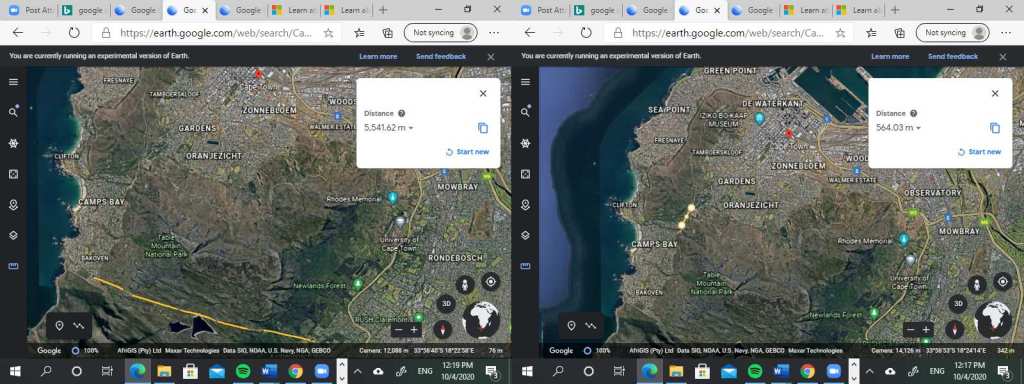
This brings up one more major leniency that could be applied to the “Table Mountain ” conundrum. (for those who have not seen the earlier posts, this is a unique feature of the City of Cape-Town, which surrounds the over 1000m base to summit peak on 3 sides. We have been discussing whether the entire mountain or parts of its can be included in the city-limits, given the rules of עבור העיר and the 4000 amos cut-off point.)

The vertical height of the mountain is well over 1000m above the sea-level neighborhoods- Up and down, that’s about 2000m from the “walking ” distance measured by google earth that can be deducted from the techum limits once one leaves the last house of the city (or from the 4000 amos cut off point for עיר העשויה כקשת!)-unfortunately, the almost 6000 metre gap measured through google earth between the two opposite legs of the city still seems to result in far too much empty space to include the whole mountain in עבור העיר.

These posts are intended to raise issues and stimulate further research and discussion on contemporary topics related to the daf. They are not intended as psak halacha.
Eruvin 56 Looking after one’s health

In loving memory of our dear Rosh-Yeshiva of Yeshiva-college, South Africa, Moreinu haRav Avraham Tanzer of blessed memory, and as we daven for a Refuah Shleima for ALL those ill with COVID-19 and other diseases

At the bottom of the previous daf, Rav Huna rules that a Talmid Chacham is prohibited from living in a city where vegetables are not available.

Rashi explains that this is because in places where vegetables are easily available, they are generally a cheap form of healthy food, which enables him to sustain himself easily and have more time to learn  – (“טוב למאכל ונלקח בזול ויכול לעסוק בתורה”)

In our world of global trade, such a thing might seem hard for the Westerner to imagine, and we indeed daven that global supply of produce will continue uninterrupted despite the current pandemic, but in days prior to modern transport, storage  and technology, this was simply not to be taken for granted- If a certain  perishable species did not grow locally, it was usually simply not available .

Given that both Eretz Yisrael and Bavel were generally arid regions, making the availability of vegetables a requirement for one’s place of abode was no simple thing ,even in the “fertile crescent” region which can hardly be called lush by temperate and tropical standards.

 Even if we could regard Rav Huna’s statement as non-authoritative halachically but more as a form of advice coded in the strong language of halacha, it certainly is a very strong statement about the importance of a healthy diet.

Although Rashi seems to understand that vegetables are not the ONLY healthy foods, and that the reason for Rav Huna’s ruling is that they are a cheap form of healthy food which will allow the scholar to maximize his learning time without having to work too hard to be able to afford it, the basic assumption that eating healthy food is an obligation remains.

The Gemara questions this ruling, not because of any doubt regarding the importance of having access to healthy food, but because of Tannaic statements that say that vegetables can actually be harmful.

It upholds Rav Huna’s ruling by distinguishing between different types of vegetables, different parts of vegetables, and different seasons (see similar discussions in Brachos  44b ), and whereas the correct approach of a Ben-Torah to specific health advice of Chazal requires its own post, the basic idea that Chazal required us to eat healthily is not open to debate.

The Rambam (Deos 4 ) codifies this idea, going a step further and claiming that the main source of illness is an unhealthy diet and lack of exercise, a claim which  has stood the test of time and is largely borne-out by modern medical studies that list poor diet, lack of exercise, and other unhealthy lifestyles (such as smoking)  as primary risk factors in most most serious diseases.

Those who attended Yeshiva College in Johannesburg can never forget the words of the school anthem “Rosh-Yeshiva we are for you, both in sports and back at school.”

Rav Tanzer זצ”ל  always drummed it into us that we were always his representatives wherever we were and needed to try our best to make a Kiddush Hashem on the sports field as much as in the classroom.

He viewed sports and exercise as an essential part of life in order to maintain physical, emotional, and social health, and strengthen us so we could better carry out our spiritual duties, something that cannot be taken for granted amongst all Teachers of Torah.

As Chazal say (Kesubos 30a)-  “הכל בידי שמים חוץ מצינין ופחים”- “everything is in the hands of heaven, except for colds and fever”- Rashi explains that these can sometimes come upon a person through negligence, presumably by not looking after one’s health properly.

Particularly during this time of lockdown and pandemic, it goes without saying that we all need to make an extra effort to look after our health, both by eating healthily and exercising as well as possible under the circumstances, and avoiding contracting or spreading the disease chalila.

With the right effort on our side, we can than daven with all our strength that Hashem keeps us all healthy, heals the ill, and brings a ישועה very soon!

These posts are intended to raise issues and stimulate further research and discussion on contemporary topics related to the daf. They are not intended as psak halacha.

Eruvin 55 The extended techum and Table Mountain continued, and self-sacrifice for Torah

Today’s daf has a solid mix of aggadic material and a return to the technical rules regarding how to work out the extended shabbos domain of a city.

I wish to start with the halachik side of the daf, כדרכינו בקודש, even though some of  the aggadic material precedes it, and hope to return to the Agadot thereafter.

For the sake of clarity, the אגדה includes all content in the Talmud that does not involve the halachik (legal) process, including מדרשי אגדה  that comment on the narrative portions of the Tanach or complement them and ethical and other advice- see מבוא התלמוד attributed by many to Rabbeinu Shmuel haNagid, one of the first of the Rishonim  and published at the back of מסכת ברכות  for his exact definition, though note that his view on the source and authority of agada is subject to much debate amongst the Geonim, Rishonim and later authorities (my in-depth Hebrew article on this subject is currently work in progress.)

We have already learnt that the general rule is that the techum (shabbos domain) of a city in which one is permitted to walk on Shabbos  stretches to a maximum of 2000 amos (between about 800-1000 m) from the last house in the city’s halachik borders (recall that 2 houses separated by 141 amos or more of empty space might be considered halachically to be in 2 different “cities.”

We have also seen recently that this applies in theory, but that in practise, the distance one may walk from the last house of the city might be significantly more, for 2 reasons:

  1. The limits of the city proper might stretch significantly beyond the last house, such as when the shape of the city is irregular (non-rectangular or grid-like) in which case some open space might be included in these limits themselves.
  • The techum of the city, while theoretically stretching 2000 amos from the end of the city-proper, is effectively measured by placing a rectangular block at the corners of the city and not a circle, meaning that while the shortest this techum will extend is 2000 amos, at the diagonals, it will extend significantly more (by pythagorus.)

The first rule is not applied universally, and one needs to be familiar with all the different shapes discussed in the sugya and which other shapes would be treated like these shapes, before jumping into using this potentially very useful tool.

For example, while a circular city has a square circumscribed around it, including the empty-space outside the circle but inside the square in the city proper itself, and a trapezium seems to be  viewed as if it is was the smallest rectangle that it could fit inside, a rectangular city is left as is, and  a parallelogram could be more complex.

There is also some discussion as to whether the square needs to be on the North-East-South-West axis of the world or can face any direction.

One of the more fascinating shapes describes is the עיר העשויה כקשת – a city in the form of a bow (or rainbow.)

The Beraisa  initially taught us that we draw a fictitious line from the one extreme of the bow to the other (this line is known as the יתר and represents the string which would be pulled back by the arrow before the arrow is released ) and view all the empty space between this line and the houses of the city as part of the city-proper, measuring the techum from this line.

However, Rav Huna rules that this only applies if the length of this line is no more than 4000 amos, allowing someone whose shabbos base or house is in the middle of this line (the spot where the arrow would be placed)  to walk to the city within his own 2000 amos (see Rabbeinu Chananel for his full explanation.)

However, if the length of this line is more than 4000 amos, the empty space is not included in the city limits, and the techum is measured from each individual house.

According to Rabbah bar Rav Huna, the space between the bow and the middle of the line also needs to be less than 2000 amos in order to include the empty space in the city proper, but according to his son, Rava, this is not necessary, and Abaya supports  his lenient view, seeing as anyone in the city could reach the middle of the  line by walking first to the end of the city.

Tosfos suggests that  according to Rava son of Rabbah bar Rav Huna, if the distance between the bow and the line itself is less than 2000 amos, the 4000 amos  restriction on the length of the line might not apply due to the same reasoning of Abaya- the midpoint of the line could be accessed through the 2000 amos or less route to the bow itself- this too is subject to debate amongst the Rishonim.

Tosfos further assumes that the 4000 amos limitation on  a bow-shaped city does not apply to the case discussed earlier where a house or row of houses  protrudes outside the grid of the city. In such a case, even if it is more than 4000 amos to the fictitious parallel row of houses we draw on the opposite end, the empty space is included in the city proper. 

Although he attempts to explain the reasons for this distinction, he admits that the Ri (one of the two most senior Baalei haTosfos) holds that this limitation applies to that case as well. Once again, this topic has generated much discussion and debate amongst the Rishonim and can also affect L shaped cities.

Though there is so much more to learn and understand regarding the above and other related issues (those whose appetite has been whet might enjoy the extensive treatment of this issue in the Rashba, Ritva, Meiri and other Rishonim) ,it is now clear that including the empty natural space between the extremes of an irregularly shaped city is far more complex than it might have originally seemed.

We are not even close to theoretically allowing climbing table mountain on shabbos or Yom-Tov  even without the other multiple halachik challenges one would face (though as per accompanying images from google Earth, it seems that the “Lions Head” Mountain might fall completely within the techum of Cape Town City, and at least on Yom-Tov where carrying is less of an issue, with the guidance of the local Rabbis and eruv experts, the gorgeous trail up and down MIGHT indeed be permissible.

In the beginning of the daf, various explanations are given of the passuk “לא בשמיים היא ולא מעבר לים היא  ” – (it is not in heaven nor is it on the other side of the sea.)

I would like to focus for a minute on the explanation of רב אבדמי בר חמא בר דוסא  who derives by implication that although the Torah is indeed reachable for us, even if it were not, we would be liable to reach to the sky and cross the sea in order to get it.

There are times indeed when Torah goals seem unobtainable to us, and although we should be encouraged by the fact that in essence, they are vey much obtainable, we need to push ourselves and be prepared for self-sacrifice in order to achieve these goals despite how unobtainable they seem.

The Rosh Yeshiva זצ”ל , Rabbi Tanzer, was a prime example of someone for whom no goal was too far away when it came to his life’s mission of spreading Torah.

Starting with the literally huge distance diagonally over the Atlantic that he set out on together with his young wife, leaving behind their friends and extended families in an era of very limited communication for what was at first envisioned as a 2 year stint in Africa, he moved onto the virtually impossible goal of turning what was then a virtual spiritual wasteland into a vibrant Torah center.

This was not a job he fulfilled from the ivory tower of an office, or even a classroom, but one that took him literally from door to door begging parents to enroll their children in his fledgling Torah day-school.

Almost 6 decades later, the Yeshiva College campus has served  as the largest center of the Johannesburg Jewish Community and educated generations of students who span the Jewish world, from Rabbis and Torah teachers to businessmen and professionals, as well as some combinations of both.

Returning briefly to the more technical parts of daf, the rather superficial summary we have done above and the fastest reading of the daf reveals how an understanding of mathematics is essential to being able to make the complex calculations needed for taking full advantage of the shabbos techum- One also clearly needs some conception of how much a factor raw mathematics was in Chazal’s reasoning, something that only a good knowledge of both Chazal’s methodology and mathematics would allow.

Though those who knew him know that Rabbi Tanzer was first and fore-most a Rosh-Yeshiva who was most at home in the Beis-Midrash and who got the most joy out of those students who went on to become serious Torah Scholars, he always pushed his students to excel in their general education as well, creating a generation of students with the knowledge required not only for their chosen careers, but also for understanding many areas of Torah that are beyond the reach of those who lack this knowledge.

The Gaon of Vilna, broadly considered the greatest Torah figure in many centuries, was famous for stating that it is impossible to fully understand the Torah without understand all the forms of general (I prefer not to use the term secular) wisdom (see “haGaon” by D.E. Eliach for citation) , something he himself accomplished, and though neither he nor our Rosh Yeshiva would encourage one to give more priority to general studies than to Torah, chalila, I personally have found great benefit from the general education I received under Moreinu haRav Tanzer and his team, not just in my business, but most importantly in so many areas of my Torah Study.

Although reaching the wisdom of the Vilna Gaon is certainly like reaching for the sky, and building en empire of Torah like the Rosh Yeshiva did is certainly also above most of us, we can learn from him to be prepared to try our absolute best, and if we do so, the results will speak for themselves, with Hashem’s help!

These posts are intended to raise issues and stimulate further research and discussion on contemporary topics related to the daf. They are not intended as psak halacha.

Eruvin 54 Beruria, Learning out loud, and Torah as a cure

In loving memory of our dear Rosh-Yeshiva of Yeshiva-college, South Africa, Moreinu haRav Avraham Tanzer of blessed memory, and as we daven for a Refuah Shleima for ALL those ill with COVID-19 and other diseases שיבדלו לחיים , among them Maran haGadol R’ Chaim Kanievsky שליט”א , and the Karliner Rebbe שליט”א. We also have in mind that great friend of Israel (אולי ככורש בדורו) , President Donald Trump- it goes without saying that we leave politics out of all the above.

As we continue to be cut-off from the batei-midrash and shuls that we hold so dear, one of the things that we all miss while learning at home is the constant buzz of Torah-learning that emanates from these sacred places.

Our halls of study are a stark contrast to the (at least officially) silent libraries and study-halls of the great universities, and are brought to life by the sounds of students and their chavrusos (study-partners) learning out loud, or even screaming in learning at one another.

This distinction is so sharp, that while I was investigating the possibility of zoom providing a feature to simulate this buzz online while still allowing people to focus at a higher volume on their chavrusos, I was told that there is simply no request for such a thing and the technology does not exist!

Our daf begins with the continuation of a story where the famous wife of Rabbi Meir, Berurya rebuked a certain student for learning silently.

We would be remiss in pointing out how despite her tremendous status in learning herself, she seems not to have allowed her own status as an אשה חשובה (“important” or noble woman) to diminish her respect for the teachings of Chazal, including even the seemingly “chauvinist” early ruling of Rabbi Yosi ben Yochanan of Yerushalayim: אל תרבה שיחה עם האשה (do not chat too much with women), something she admonished none other than Rabbi Yosi haGalili for at the bottom of the previous daf!

(This makes a cryptic Rashi who explains the מעשה דברוריה referred to by Chazal (A.Z. 18b ) as a case where she made light of Chazal’s statement that נשים דעתם קלות even harder to explain, but that’s for another discussion, Hashem willing!)

Back to her rebuke of this student, she based this on the passuk “ערוכה בכל ושמורה” (set out in everything and looked after)- “If one’s Torah is set out in all 248 of one’s limbs ( learnt with one’s entire body,) it is looked after (and endures), otherwise it is not.”

The Gemara continues bringing various other statements about the importance of learning out loud, among them the case of a certain student of Rabbi Eliezer who learnt silently and forgot his learning after 3 years.

This leads into another discussion regarding the healing powers of Torah:

One of the pessukim brought to highlight the importance of learning out loud is “כי חיים הם למצאיהם ולכל בשרו מרפא “- the word מצאיהם is read for the purposes of this derasha as מוציאיהם and the passuk is thus rendered as “They (the words of Torah) are life for all those who bring them out (of their lips) and a cure for all his flesh.”

After the Gemara brings various other pessukim to show that the recommended action for one who has a headache, stomachache ,sore-throat, or pain in the bones is to יעסוק בתורה , busy oneself’ with Torah, it uses the second part of the above-quoted passuk (a cure for all flesh) to show that the remedy for pain in the entire body is also to busy oneself with Torah!

However, we also know from earlier discussions (see my posts on Shabbos 61 and 67) that using the Torah as a source of healing can be problematic, to the point that it is a severe prohibition to whisper a verse in order to heal a wound (see Mishna Sanhedrin 11/1) and Shvuos 15b)- this prohibition is taken so seriously by the Rambam, that he writes (A.Z. 11/12) that one who does this has not only transgressed a serious prohibition, but has made light of the Torah which is meant as a cure for the soul, by turning it into a bodily cure like mere medicine.

Whereas the above Rambam rules that it is permitted to say Tehillim for someone who is healthy so that the merit of learning Torah will protect him, he seems to view even the common practise of saying Tehillim for someone who is ill as incorrect, based on this prohibition. Yet it seems pretty clear in the verse we have quoted and the Gemara’s derivation from it that the Torah is indeed a cure for the entire body and that learning Torah as a remedy for physical pain is indeed recommended!

I am not sure how to reconcile this piece of Gemara with the Rambam, and I am not even sure if the Rambam viewed this possibly aggadic material to be authoritative enough to affect his ruling, which is based on how he learnt other more clearly halachik sugyas, but one must certainly acknowledge that a simple reading of this Gemara seems to indicate that Torah is certainly a valid therapy for physical pain, whether this effect is psychological or metaphysical.

One of the things that is most characteristic of great Torah personalities is the constant sound of Torah that comes from their lips- Everyone who knew the late Rosh Yeshiva, Rabbi Tanzer זצ”ל, remembers the almost constant sound of Torah and prayer emanating from his lips, whether he was at home, in his office, or the Beis-Midrash and shul, as well as when he was not feeling so good.

His learning was a constant song of praise to Hashem, and his signature hum displayed the sheer pleasure he got from his Torah and davening- Who can forget the melody of his signature “הבוחר בעמו ישראל באהבה…שמע ישראל ” or “אני מאמין” and the traditional Yeshivish chant to which he sang the words of Chazal that he learnt and taught?

May our own learning reveal the joy of Torah that he taught us, and may the merit of his Torah and all the Torah we learn because of him truly protect all of us from this terrible plague and all the other challenges life brings us, ודיה לצרה בעתה.

And may Hashem soon spread out upon us the ultimate place of Torah and protection , the fallen Sukkah of David, from where the sounds of the greatest Simchas haTorah imaginable will once again emanate, as we celebrate Simchas beis hashoeiva and hafakos in the newly-built Beis haMikdash, במהרה וימינו אמן.

These posts are intended to raise issues and stimulate further research and discussion on contemporary topics related to the daf. They are not intended as psak halacha.

Eruvin 52 and 53  The enlarged techum, nature walks on Shabbos, and Agada

Queenstown/New-Zealand: techum options?

In loving memory of our dear Rosh-Yeshiva of Yeshiva-college, South Africa, Moreinu haRav Avraham Tanzer of blessed memory, who passed-away peacefully Tuesday night in Johannesburg.

It has been my great privilege to work in the international travel space, with the opportunity to show people so many of the wonders of Hashem’s creation around the world.

One of the highlights of spending a Shabbos in such places is the opportunity to enjoy spectacular shabbos walks amongst gorgeous scenery.

Of course, while going for a pleasurable walk on shabbos is a great way of fulfilling the mitzva of oneg shabbos, and might thus even be considered a mitzva as far as certain laws are considered (making an eruv techumim for example,) one has to be aware of the halachik issues involved, amongst them the prohibition against carrying on shabbos outside a closed area and the prohibition of leaving one’s shabbos domain/techum.

One who camps out in nature is very limited by the later and will usually only be allowed to walk within a 2000 amos range of his tent, even if he is not carrying anything.

In fenced resorts, so long as the entire area is מוקף לדירה  (fenced for the sake of human habitation,) one might be able to measure the techum from the fence of the resort.

Moreover, in resort towns and cities, one might be able to measure the techum from the last house of the city, baring in mind that legal city limits and halachik city limits are not the same thing, and that a gap of more than  140 amos between houses or property walls might be considered a break between two halachically separate cities.

This can mean that in spread-out suburbs or resort towns, one might not even be able to walk from one side of the town to the other, and would be limited to 2000 amos from the building or fenced-in property one is staying in, placing a rather substantial limitation on one’s walking options on Shabbos.

The Mishna at the bottom of Eruvin 52 has some consolation, however, which can be very significant:

Although the space between houses that is permitted for them to be considered part of the same town is rather small, the idea of the עבור העיר – extended halachik limits of the city (as in a שנה מעוברת  [leap or extended year] or אשה מעוברת  [pregnant woman], or according to a different version debated on Eruvin 53, אבר (limb) or extra components of the city) means that substantial amounts of empty space might indeed be included in the halachik city limits.

For example, if a house of the city protrudes on its one side (the north-east corner as per Rashi’s example)  forming an irregular shape, we draw a fictitious protrusion opposite it (on the south-east corner) , and then “square” the city with a perpendicular line from the original protrusion to the fictitious one, including the empty space in-between within the city proper.

We will also  see  (Eruvin 57b) that this also applies to other irregularly shaped towns that do not form a typical square or rectangle style grid, and by using this method, large areas of open natural space can often be included in the limits of the city proper, before we even start measuring the 2000 amos techum around it, which we have already seen is also squared in a way that makes it effectively significantly bigger (Eruvin 49b.)

Chazal determined (Eruvin 57b)  that the techum of shabbos needs to be measured physically with a rope 50 amos long, a point which Rashi uses on our daf (Eruvin 52b at the bottom) to explain the view that there is a 15 amah safety net for someone who mistakenly left the techum, a topic I would love to analyze further in the context of halachik safety-nets in general.

As such,  whether one may rely on satellite images such as those available on google earth to measure this techum, or even on a car’s distance metre, is for a different discussion, one I hope to go into when we get there, Hashem willing.

The process of measuring the techum was taken very seriously in Chazal’s time, and markers were placed on the roads to show where the techum ends, as Rashi on our daf also points out.

Given that sufficiently measuring the techum for a once-off trip might not be feasible, and does not even seem to be common -practise in fixed  Jewish communities, possibly because of the common use of Eruvin, the practical use of these very powerful tools might be limited by pragmatism, but one who knows these laws sufficiently should be able to at least pre-measure the route of any planned  nature-walks as well as map-out the shape and geography of the town before shabbos, in order to ensure than everyone can enjoy these gorgeous walks in a halachically correct manner.

In my first post on this masechta, I recalled how despite my fondness for it, there was some concern raised as to how I would be able to keep up with contemporary relevant posts given its technical nature.

I noted then that besides for the great opportunity to focus on some of the most important rules of Eruvin, Shabbos, and halachik psak in general, there are also plenty other topics in the masechta, and even a fair amount of aggadic material, even if less so than  in the first two masechtos in the shas.

In fact, my affection for Eruvin started during my time as a Rebbe in Yeshiva-College, under the late Rosh-Yeshiva Rabbi Tanzer זצ”ל  and יבל”א  his son Rav Dov Tanzer שליט”א, himself a revered Torah giant of note who mentored me not only in chinuch but in the intricacies of constructing eruvin in the many resorts we used for school Shabbatonim and seminars I ran.

I also pointed out that sometimes Chazal used some of the most technical of discussions to teach us some of the most relevant general principles of halacha and Torah life, and that as we focus on the equally essential minute details of each subject, we need to constantly keep our eyes open for these messages.

Today’s daf is one of those, and while it starts with the extremely technical methods used to calculate the extended borders of a city, it moves onto a wealth of aggadic (non-halachik) material.

There is much discussion from Chazal to the Rishonim and beyond as to the status and role of this kind of aggadic material, which the Rambam teaches us contains the secrets of the Torah (Pirush haMishnayos/intro to חלק), but without detracting chalila from their sanctity and importance, Rashi  (Shabbos 30b ) explains that Agadot are a genre used to draw close the hearts of people and get them interested in the material about to be taught.

Chazal were fully aware that as human beings, we love stories and allegories, and that before, after, and sometimes in the midst of our delving deep into complex halachik intricacies, some of their great non-halachik teachings and traditions should be brought delivered in this format.

Going further, the Amora Rabbah was always particular to start every learning session with a   מילתא דבידוחתא, literally a matter of a joke )Shabbos 30b.)

Given that even the everyday chatter of Torah scholars requires study )A.Z. 19b) , there is little doubt that even these jokes contained wisdom, and are certainly different to the extremely frowned upon ליצנתא  (cynical or mocking humor) which Chazal (Derech Eretz 5/5) warned us against.

Our beloved Rosh-Yeshiva, Rabbi Tanzer of blessed memory, as with everyone in his life and career, followed in Chazal’s path, and always started his words of Torah with a joke or story, which in his wisdom he linked and made relevant to the material he was about to teach.

A master of human-nature almost impossible to find, we can never replace him, but we can certainly do our best to follow in his ways, if only our everyday chatter could come close to the level of his.

These posts are intended to raise issues and stimulate further research and discussion on contemporary topics related to the daf. They are not intended as psak halacha.